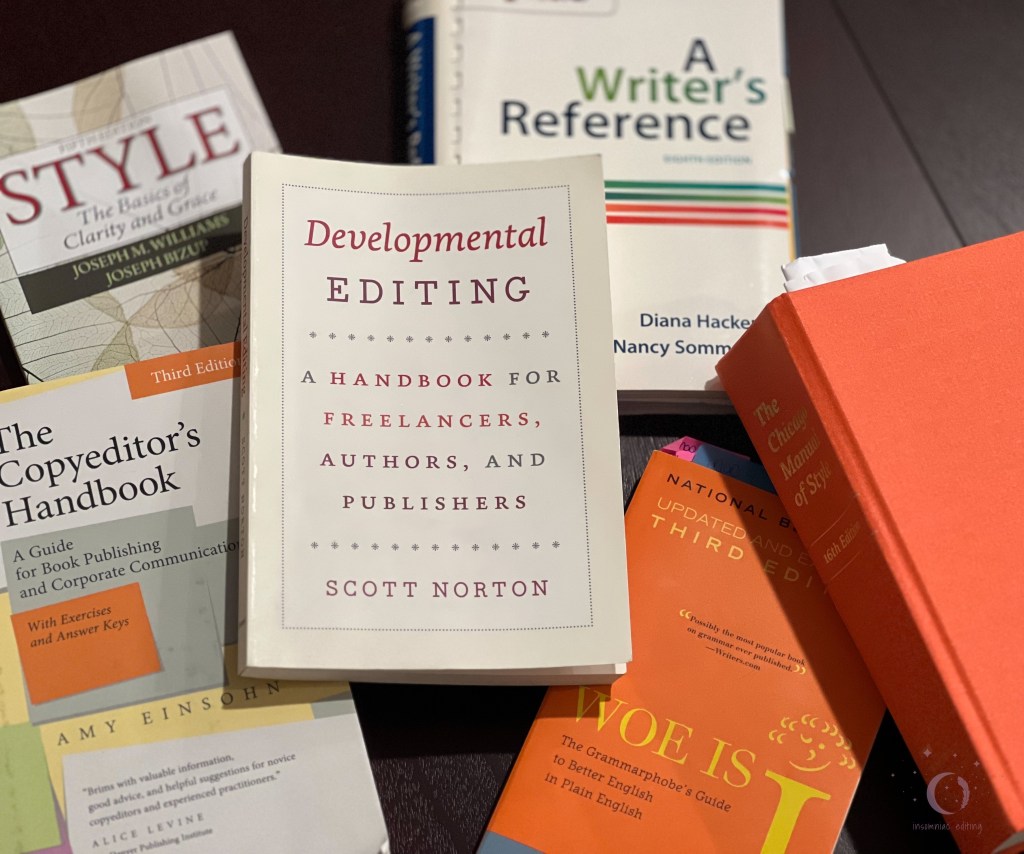
Using online resources like CMOS Online, updated e-books, and other relevant and credible sources, Insomniac Editing utilizes the most up-to-date information.
So Many Edits! What Do I Need?
I get it. It’s totally confusing. As a writer, I’ve seen many professional websites where definitions for editing terms do not match. I most often see developmental and substantive edits used interchangeably, just as I’ve seen substantive, line, and copyediting defined as the same across different websites.
So what’s that all about? An editor’s background, education, and preferences can explain why terms differ, as well as the style guide they use.
Are they wrong? No, but when picking an editor, read about their services to understand how they define these terms and what they offer. If they do not list definitions or explanations, then reach out to them to find out.
Definitions of Editorial Services
(Even among these industry leaders, there are differences)


My experience earning the Professional Sequence in Editing Certificate at UC Berkeley Extension defined my services in the past; however, I’ve recently updated these definitions to be in-line with the EFA’s 2024 rate chart.
I follow The Chicago Manual of Style as my preferred style guide, but I understand many authors have a style or preference for certain stylistic choices. As part of my onboarding and editing process, I discuss these issues with new clients and adjust my style sheet per these discussions. Please find definitions for my editorial services below.
Manuscript evaluation is a big-picture analysis of the manuscript. It looks at structure, story, mechanics, genre, and more. The manuscript evaluation is less detailed than a developmental or line edit. There will not be any tracked edits or comments on the manuscript. Since it takes less time, it is a more affordable option. Clients receive an editorial letter explaining how to apply feedback. Partial manuscript evaluations are available for authors who need feedback on specific areas. ~ $45 per hour
Book Coaching (sometimes referred to as a Developmental Edit) starts in the planning stages. It is a collaborative effort between the editor and author, which is why good relationships are essential. This process shapes a book from outline and character design to chapter-to-chapter edits. Having a book coach is like having a cheerleader, project manager, editor, guide, and mental health advocate along the way! It can include providing materials on best practices, giving advice, and sharing market information. ~ $60 per hour
Developmental Editing (sometimes called Substantive Editing) is a big-picture edit on a completed manuscript. A developmental edit looks at structural issues, plot (flow and holes), sequencing, pacing, point of view (POV), setting, character development, continuity, consistency, and more. The result of this edit could mean moving chapters and paragraphs around or, in some cases, significant rewrites. ~ .035¢ per word
Line Editing (also sometimes called Substantive Editing) focuses on the craft of writing. This edit will look at improving language, style, rhythm, and structural editing on a paragraph and sentence level. The line edit will double-check continuity and consistency. Fact-checking and research fall under this edit.
Developmental and Line Edits are a single service and, as a result, require two rounds of edits. Clients will receive a style sheet at the completion of this service. ~ .06¢ per word
Publish- or Submission-Ready Packages include the developmental and line edit, along with a copyedit and proofread. Copyediting focuses on grammar, mechanics, spelling, punctuation, hyphenation, and more, while proofreading ensures a clean manuscript. This package requires multiple edits, usually four. Clients will receive a style sheet at the completion of this service. ~ .09¢ per word
Style sheets include
- Reference sources
- Style choices for symbols, dates, numbers, punctuation, and more
- Fact-checked items
- Words unique to the manuscript
- Self-editing advice for future projects based on errors found during the editing process
Do I Really Need an Editor and Why?
This is such a good question. Unless you have magic, divine intervention, or are just incredibly talented (which some are), you need an editor. Even writer-me needs an editor. I may not need as much help with the grammar and mechanics, but editors do so much more than that. I need an editor because, as a writer, I might miss plot holes or unnatural-sounding dialogue. Sometimes we writers forget to tell our audience vital information because we know it, but it doesn’t make it to the page. An editor will find this. They will find inconsistencies and continuity errors, and so much more! For this and many other reasons, editors are invaluable.
Can’t I use Grammarly, Word Editor, or one of the other grammar checkers? These programs use algorithms and AI. They can alert you to mistakes like dangling modifiers, comma splices, and finding passive voice in your work, but not always. In fact, they can introduce errors in a manuscript because they look at precise rules. They do not recognize some irregular uses of verbs. Though they alert you to comma splices, they can also create comma splices with suggestions or take commas out when they are necessary. Editing software can’t see plot holes, pacing, or character development issues. They may suggest better word choices, but these sometimes change a sentence’s meaning. Editing software has its place. It can clean up your work, but it hasn’t gotten to the point of replacing a human edit.
Are all editors the same? No. Beyond the fact that editors specialize in different subjects, editors just edit differently. Education, experience, preference, and personal perspective can affect an edit. Like no two snowflakes are the same, neither are the edits from two editors on the same manuscript. And even though grammar has set rules, there are traditional and modern grammarians who interpret them.
Grammarians? Did you know grammar rules change? Why? Language is living and ever-changing due to shifts in culture and convention. Traditional grammarians follow standard rules like never ending a sentence with a preposition or no fragments, to name a few. Modern grammarians worry less about the preposition rule and will allow fragments where they add emphasis. There are debates among grammarians and editors about words like “all right” and “alright” and the Oxford comma (follow the links if you’re curious). It should be easy to see who falls where on these arguments. (My preference is “all right” in text and the informal “alright” in dialogue. And I am Team Oxford comma.)
I encourage writers to utilize free sample edits and manuscript evaluations. They will allow you to see the differences between editors, check out their communication styles, and decide who is right for you.
Am I Ready? Resources and Tips to Get You There
You’ve just finished your first draft. Congratulations!! Now it’s ready to go to an editor, right? Wrong. Unless you have that magic or divine intervention previously stated, you’re likely not ready for an editor. There are a lot of things you can do to get prepared.
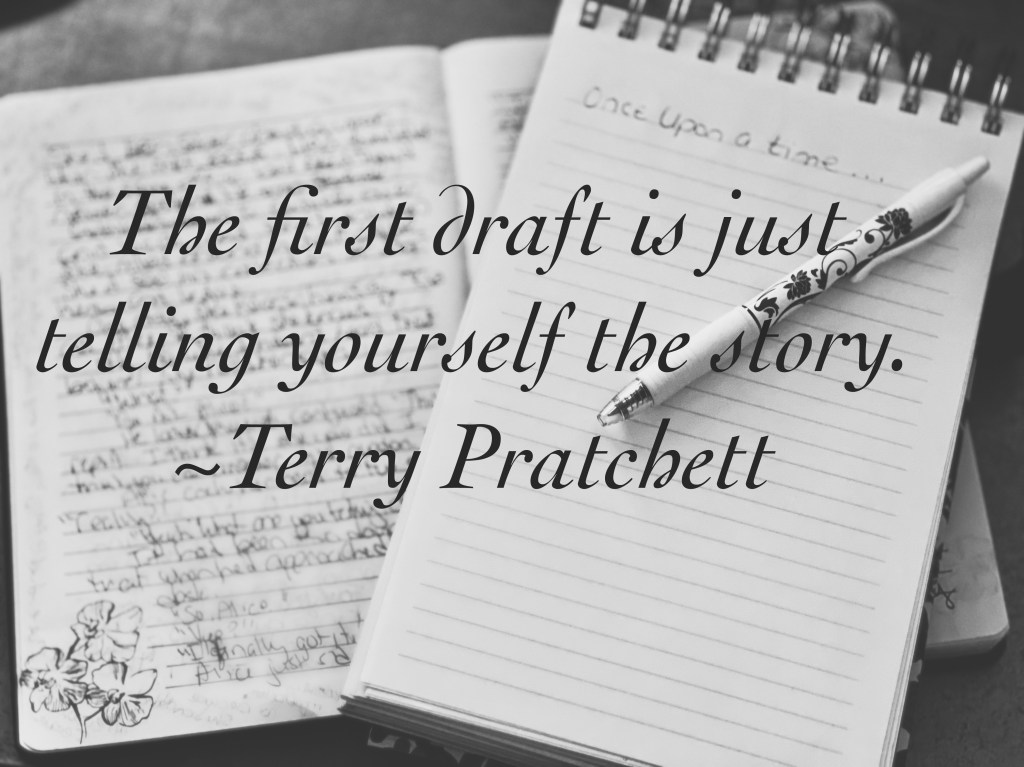
Terry Pratchett said, “The first draft is just telling yourself the story.” In her book, Seven Drafts, Allison K Williams describes the first draft as your “vomit draft.” (Probably not something you want to send to an editor!) Before you invest in editing, consider the following:
- Have someone, a friend or family member, read your work. Pick someone who will be honest with you and not just someone who will spare your feelings. Honest feedback makes your work better.
- If you have a writing partner, let them read it. Are you part of a critique group? Pass it by them first. Having someone else who’s in the business read your book before sending it to an editor can be invaluable. Will they see everything an editor will? No, but they will save you a lot of money by taking those first looks. They might find holes in your plot or problems with your characters. This type of feedback gets you started on subsequent drafts and revisions.
- Let it gestate. John McNally’s Vivid and Continuous: Essays and Exercises for Writing Fiction has an entire chapter dedicated to gestation. (In general, the book has a lot of great points for writers!) McNally says, “I tend to think that every piece of fiction has a gestation period during which the story or novel needs time to percolate in the writer’s head in order for it to make sense.” This gestation period is different for every writer. It could be a few days, months, or years. Many writers finish a draft, put it away, and start another project. The time and space away from the original project allow them to look at it with fresh eyes when they come back to it. At this point, it’s easier to see plot holes, character development, and pacing issues.
- Consider a free sample edit or a partial manuscript evaluation. An editor can tell a lot about your book and writing from the first five to ten thousand words.
Resources
Allison K William’s book, Seven Drafts: Self-Edit Like a Pro from Blank Page to Book, takes authors through the six drafts a writer should complete before that final seventh draft, which might be ready for an editor. If you’re looking for advice on self-editing, this is a great book to pick up.
If you’re looking for agent representation and want to go the traditional-publishing route, Elizabeth Kracht’s The Author’s Checklist is a must! As an agent, she possesses a wealth of information and provides an A-Z list of helpful tips for any author regardless of where they are in their career. It’s also great for self-publishers. (‘◡’)
The title of Jane Friedman’s, The Business of Being a Writer, says it all. Jane walks you through the business of being a writer, from whether you can make a living as a writer to publishing to freelancing.
As previously mentioned, John McNally’s Vivid and Continuous: Essays and Exercises for Writing Fiction is full of advice. He talks about craft, the ideal reader, titles, the narrator’s likeability, immediacy, and many other important details. The book also includes an extensive further-reading list for writers who wish to continue learning.
Published authors can be another valuable resource for you. Whether you like his work or not, Stephen King has many great suggestions in On Writing: A Memoir of the Craft. Tomi Adeyemi created The Writer’s Roadmap. And last fall, Fredrik Backman started posting writing tips on Instagram.
In addition, there are dozens of podcasts by agents, authors, and editors and many great resources for writers to learn more about their craft and self-editing. This preparation can save money when it comes to professional editing services.
 Insomniac Editing